
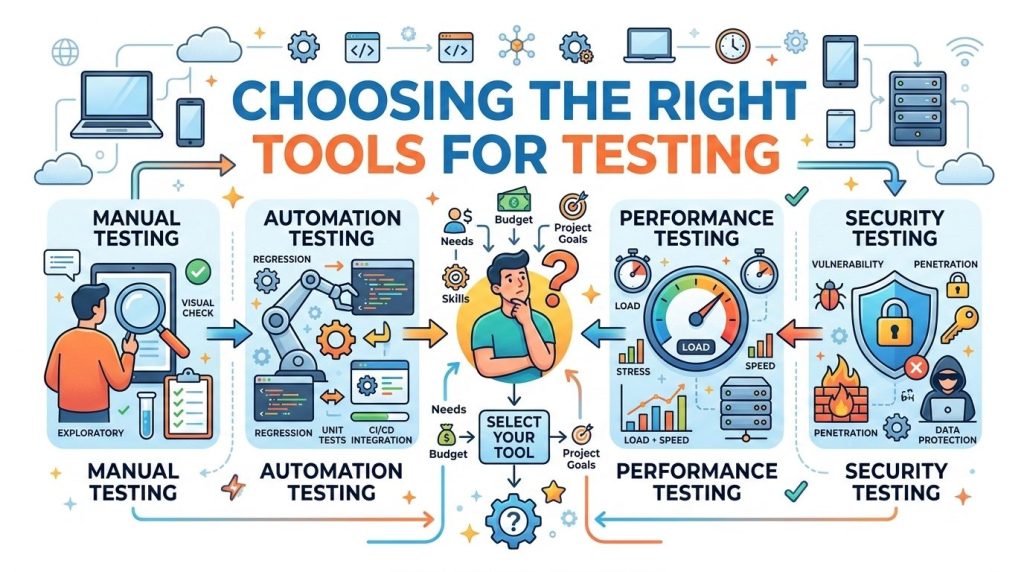
As development teams scale, QA managers face increasing challenges — faster releases, complex environments, and higher expectations for quality. The right QA tools can streamline processes, strengthen collaboration, and support faster delivery. The goal is not to use more tools, but to choose the ones that truly fit your team’s maturity and workflow.
🧩 1. Understand Your Team’s Needs
Start by assessing where your QA team stands today. Consider team size, skill levels, and testing approach. Automation-heavy teams need flexible scripting tools, while manual testers benefit from intuitive, easy-to-use platforms. Also evaluate your development methodology — Agile, DevOps, or CI/CD pipelines require tools that integrate seamlessly. Identify current pain points like slow test case management, flaky automation, or limited reporting. A clear baseline helps you choose tools that solve real problems.
⚙️ 2. Prioritize Integration
Even the most powerful tool becomes a burden if it doesn’t fit into your ecosystem. Ensure your QA tools integrate with CI/CD systems (Jenkins, GitHub Actions), issue tracking (Jira, ClickUp), version control (GitHub, GitLab), and communication platforms (Slack, Teams). Strong integrations reduce manual work, automate feedback loops, and improve transparency across teams.
🤖 3. Balance Automation & Manual Testing
Automation is crucial for scaling QA, but manual testing remains essential for usability and exploratory scenarios. Choose automation tools that offer stable execution, support familiar languages, and provide low-code options. At the same time, manual testing tools simplify capturing evidence and reporting of bugs.
📊 4. Focus on Reporting & Traceability
Growing teams need clear visibility into quality metrics. Look for tools that provide customizable dashboards, requirement–test–defect traceability, and easy reporting. Open APIs ensure your data stays accessible as you scale.
🏁 Conclusion
Choosing the right QA tools is about enabling smarter, faster, and more transparent testing. When tools align with your workflows, integrate smoothly, and support both automation and manual efforts, they empower your team to deliver high-quality releases consistently. Ultimately, great QA comes from skilled people supported by the right toolset.


