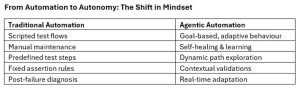
In today’s fast-paced software world, traditional test automation is hitting its limits. Scripts break with UI changes, test maintenance is costly, and static flows can’t keep up with rapid releases. The solution? Agentic Test Automation — where intelligent software agents autonomously plan, execute, and optimize testing.
What Is Agentic Test Automation?
Agentic Test Automation introduces goal-driven, adaptive test agents that mimic skilled QA engineers. These agents:
- Understand testing goals
- Adapt during execution
- Learn from past results
- Collaborate with other agents and humans
They’re context-aware and proactive, transforming QA from reactive scripts to cognitive systems.
Why It Matters
Old-school automation is fragile and reactive. Agentic automation is:
- Resilient to UI/API changes
- Adaptive to new features without rework
- Risk-aware, prioritizing business-critical paths
- Proactive, reducing bugs before they hit users
This shift empowers QA teams to scale testing with speed and precision.
Core Capabilities
- Goal-Oriented Execution: Agents optimize test flows to meet outcomes like “validate login” or “verify checkout.”
- Context Awareness: They adjust to changes in real time—UI shifts, API failures, or data updates.
- Self-Healing Scripts: Agents recover from broken selectors using AI and historical patterns.
- Continuous Learning: Agents learn from test results, improving coverage and reducing noise.
- Cross-Agent Collaboration: They coordinate multi-user and multi-system scenarios like real users would.
Real Use Cases
- Login/MFA flows
- E-commerce checkouts
- Real-time dashboards
- AI/ML output validation
Integration & Benefits
Agentic agents plug into CI/CD pipelines, observability tools, test management, and issue trackers. Paired with a Mission Control Platform (MCP), teams can centrally manage, track, and govern autonomous testing.