
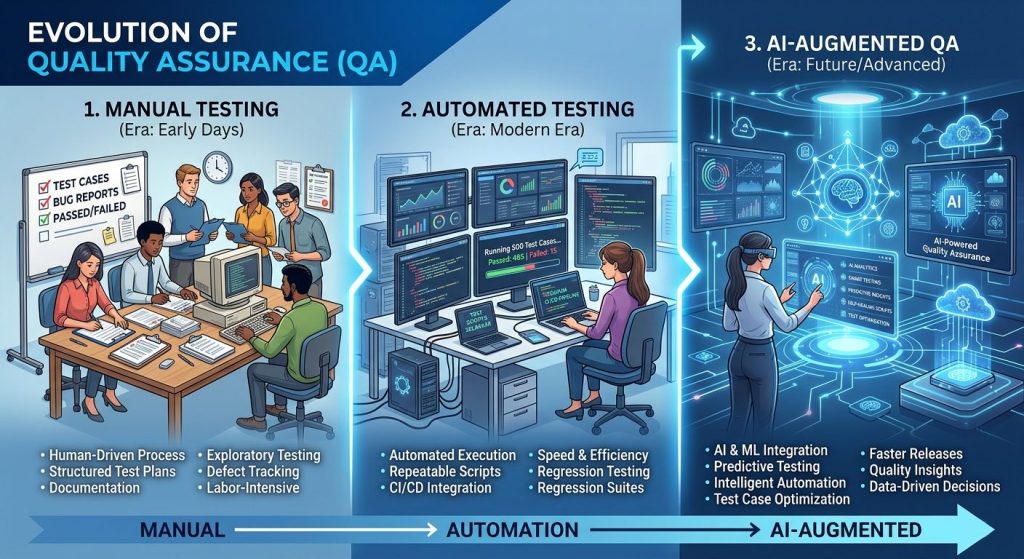
Software Quality Assurance (QA) has evolved significantly over the years. What started as a manual, checklist-driven activity has transformed into an intelligent, automated, and AI-powered discipline. Each phase of this evolution has helped teams deliver better software at higher speed and with improved customer experience.
This blog highlights the three major stages in the evolution of QA and what they mean for today’s quality teams.
1. Manual Testing Era: Human-Centric Quality
In the early years of software development, testing was a fully manual effort. Testers executed steps one by one, explored applications from a user perspective, and logged issues directly to developers.
✔ What Worked Well
- Strong user empathy and exploratory testing skills
- Flexible test execution based on real-world scenarios
- Effective for usability, visual checks, and user experience testing
⚠ Limitations
- Time-consuming and repetitive
- Limited regression coverage
- Bugs were found late, making them more costly to fix
As applications became more complex and release cycles became shorter, manual testing alone could not keep up — paving the way for automation.
2. Automation Era: Speed and Continuous Testing
To accelerate delivery and support Agile and DevOps practices, QA shifted towards automation. Engineers began building test scripts and frameworks to run tests faster and more consistently. Continuous testing became a core part of the CI/CD pipeline.
Popular Tools: Selenium, JUnit, TestNG, Cypress, Postman, Cucumber
🚀 What Automation Improved
- Much faster regression testing
- Higher test coverage across browsers, devices, and platforms
- Early and continuous feedback via CI/CD integration
- Reduced manual effort for repetitive testing tasks
⚠ New Challenges
- High maintenance of test scripts and locators
- Flaky tests caused by frequent UI changes
- Increased need for coding and technical skillsets
Automation made testing faster and scalable, but it was still limited by human-created scripts. QA needed a more intelligent and adaptive way to ensure quality — leading to AI-powered testing.
3. AI-Augmented QA: Intelligent, Predictive & Adaptive
The latest evolution of QA introduces Artificial Intelligence and Machine Learning into the testing lifecycle. AI doesn’t just run tests; it learns, adapts, and helps improve the quality process.
✨ How AI is Transforming QA
- Smart test generation: Creates test scenarios using requirements, user flows, and production usage data
- Self-healing automation: Automatically updates tests when UI changes
- Predictive risk analysis: Identifies high-risk areas before testing begins
- Autonomous testing: AI bots explore the application and detect unexpected behaviours
- Faster root-cause analysis: Groups failures and analyses logs to suggest likely issues
Examples of AI-Driven Testing Tools: Mabl, Testim, Functionize, Applitools, LaunchDarkly
Where QA Stands Today
QA professionals are no longer just “test executors.” The role has evolved into a strategic, analytical, and engineering-focused function.
Today’s QA teams are expected to:
- Influence product quality decisions early
- Use data and AI insights to prevent defects
- Combine human judgement with intelligent automation
- Ensure a great customer experience beyond functional testing
- Modern QA is becoming a blend of technical, analytical, and strategic leadership.
⭐ Final Thoughts
The journey of QA—from Manual to Automation to AI-Augmented—shows how the discipline continues to grow in value. Manual testing-built user empathy, automation brought speed and scale, and AI is now adding intelligence and predictability to quality.


